

The growth of e-commerce has changed the way businesses sell products, manage transactions and maintain financial records. Many businesses now operate across marketplaces such as Amazon, Flipkart, Meesho and other online platforms.
For accountants and Chartered Accountant (CA) firms, this growth has introduced a new layer of accounting complexity.
Unlike traditional businesses that may work with a relatively straightforward sales and payment process, marketplace sellers receive multiple reports covering orders, settlements, returns, refunds, marketplace fees and tax-related transactions.
When a CA firm manages several e-commerce clients, the challenge becomes even greater. Every client may use a different marketplace combination, accounting application and reporting procedure.
This makes an organised marketplace accounting workflow increasingly important.
1. Managing Multiple Clients with Different Accounting Requirements
A CA firm may manage accounting and compliance-related work for several e-commerce businesses.
One client may sell primarily through Amazon, another through Flipkart, while a third may operate on Amazon, Flipkart and Meesho simultaneously.
Their accounting software may also differ.
For example:
- Client A uses TallyPrime.
- Client B maintains accounts in BUSY.
- Client C uses Zoho Books.
- Client D manages multiple GST registrations and marketplace accounts.
The accountant must understand each client’s reporting structure and prepare accounting information in the appropriate format.
Without a consistent workflow, the same type of accounting activity may require different manual procedures for every client.
2. Marketplace Reports Are Not Standardised
One of the biggest challenges in e-commerce accounting is the difference between marketplace report formats.
Each marketplace may provide separate reports for:
- Sales and order transactions
- Settlement and payment details
- Customer returns and refunds
- Commission and service charges
- Shipping and fulfilment expenses
- GST-related information
- TCS and other applicable tax deductions
Even when two reports contain similar financial information, their column names, transaction references and structures may differ.
Accountants often need to spend time understanding these files before they can begin preparing accounting entries.
A standardised report-processing approach can make this process more manageable.
3. Settlement Reconciliation Requires Detailed Review
Marketplace settlement reconciliation is another important responsibility.
The amount deposited into a seller’s bank account is not necessarily equal to the gross sales recorded during the same period.
The settlement may include adjustments for:
- Customer returns and refunds
- Marketplace commissions
- Shipping and fulfilment charges
- Other service fees
- Tax-related deductions
- Previous-period adjustments
For example, a marketplace may report gross sales of ₹5 lakh, but the bank settlement may be lower after returns, fees and other adjustments.
Accountants need to identify how the settlement amount was calculated rather than simply recording the bank credit as sales.
A structured reconciliation process helps explain the differences and provides a clearer picture of marketplace financial activity.
4. GST Accounting Adds Another Layer of Complexity
E-commerce accounting also requires careful attention to GST-related transactions.
Depending on the nature of the transaction and applicable provisions, accountants may need to review:
- Output GST on taxable sales
- GST adjustments for returns and credit notes
- GST charged on marketplace services
- Tax collected at source (TCS), where applicable
- Other relevant tax deductions and reconciliations
These components should be reviewed separately and mapped to appropriate accounting records.
CA firms also need to ensure that marketplace reports, accounting records and relevant tax statements can be compared during their review process.
The applicable treatment should always be checked against current GST rules and the client’s specific circumstances.
5. Why Manual Excel Processing Becomes Difficult at Scale
Excel is a valuable tool for accountants. It can help filter large reports, calculate totals, match transaction references and prepare accounting data.
However, when multiple clients and marketplaces are involved, manually maintaining separate Excel files and macros can become difficult.
Common operational challenges include:
Multiple file formats: Each marketplace may require a different processing method.
Changing report structures: Marketplace column names and report formats may change over time.
Repeated manual work: Accountants may need to copy, filter and reorganise similar information repeatedly.
Version management: Maintaining separate macros and workbooks for different clients can create maintenance problems.
Validation difficulties: Identifying duplicate transactions, missing references and settlement differences requires additional review.
The objective should not be to eliminate Excel entirely, but to reduce repetitive processing and make the overall workflow more consistent.
6. A Better Workflow for E-commerce Accounting Teams
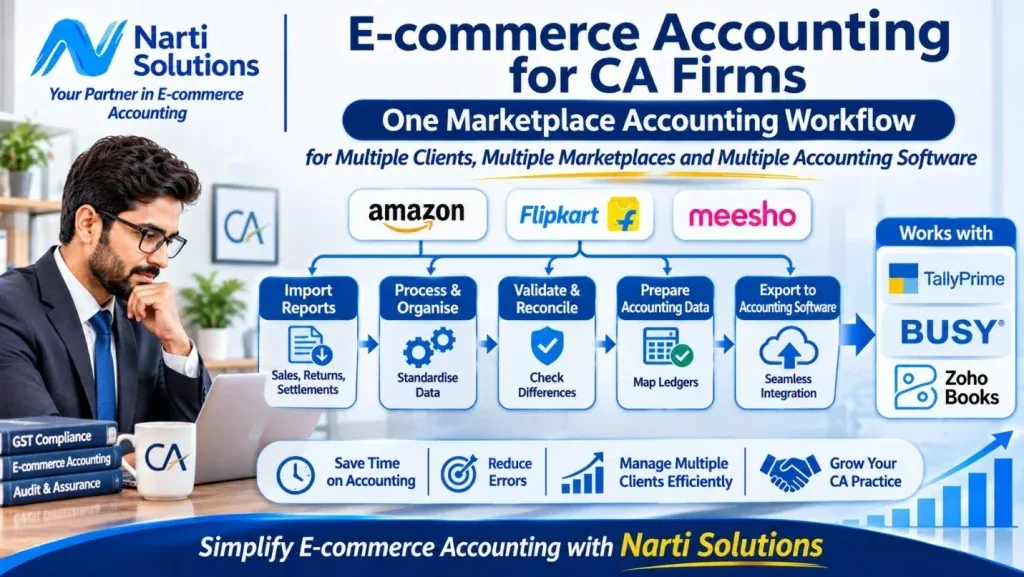
A structured marketplace accounting process can separate report collection and processing from the final accounting application.
A practical workflow can include five stages.
Stage 1: Collect Client-Wise Marketplace Reports
Organise reports according to the client, marketplace and relevant accounting period.
This helps maintain clear separation between different businesses and their financial information.
Stage 2: Process Transaction Data
Convert supported marketplace reports into organised transaction records.
These may include sales, returns, refunds, fees, settlements and applicable tax details.
Stage 3: Validate and Reconcile
Review potential duplicate entries, missing references, incomplete information and differences between marketplace settlements and bank credits.
Stage 4: Map Accounting Ledgers
Prepare suitable mappings for sales, returns, expenses, taxes and settlement-related accounts.
Ledger mappings should be configured according to each client’s accounting structure.
Stage 5: Prepare Data for Accounting Software
Generate accounting-ready information using the appropriate supported workflow for TallyPrime, BUSY or Zoho Books.
This approach allows the accounting team to follow common processing steps while retaining the accounting application preferred by each client.
7. Why CA Firms Should Consider a Dedicated Marketplace Accounting Tool
As the number of e-commerce clients increases, accountants may benefit from a dedicated solution for marketplace report processing.
Such a solution can help reduce repetitive data preparation and create a more consistent process across clients.
A suitable workflow should support:
- Multiple marketplace report formats.
- Client-wise data organisation.
- Sales, returns and settlement processing.
- Marketplace fee classification.
- Data validation and review.
- Accounting ledger mapping.
- Output for different accounting applications.
The important consideration is not simply the number of supported marketplaces. The tool should also fit the firm’s existing accounting procedures and provide sufficient visibility for professional review.
8. How Narti Solutions Supports Marketplace Accounting Professionals
Narti Solutions is designed to help e-commerce sellers, accountants, bookkeepers and CA firms organise marketplace report processing.
The platform focuses on bringing supported marketplace reports into a structured workflow and preparing accounting-ready data for different accounting applications.
Its workflow includes:
Marketplace report processing: Import and organise supported reports from e-commerce platforms.
Transaction organisation: Arrange sales, returns, fees, settlements and other transaction details.
Validation: Identify potential inconsistencies and missing information for review.
Accounting preparation: Map processed transactions into relevant accounting fields.
Accounting software workflows: Prepare data for supported workflows involving TallyPrime, BUSY and Zoho Books.
AI-assisted data processing can also help organise information and highlight potential inconsistencies. The accountant remains responsible for reviewing the records, confirming ledger treatment and verifying tax-related entries.
For CA firms managing multiple clients, this type of workflow can provide a more organised way to handle recurring marketplace accounting tasks.
9. What CA Firms Should Evaluate Before Choosing a Solution
Before adopting any marketplace accounting tool, firms should consider several practical factors.
- Marketplace coverage: Does the solution support the marketplaces and report types used by their clients?
- Accounting compatibility: Can it prepare data for the firm’s preferred accounting applications?
- Client management: Can different client records and accounting configurations be maintained separately?
- Validation controls: Does the workflow help identify missing, duplicate or inconsistent records?
- Ease of use: Can accountants process reports without depending on extensive manual intervention?
- Support and updates: Is the solution maintained when marketplace report formats change?
A tool should be evaluated using actual client reports and a complete accounting workflow before being adopted across the firm.
Conclusion
E-commerce accounting is becoming an increasingly important area for CA firms and accounting professionals.
Managing multiple clients across Amazon, Flipkart, Meesho and other marketplaces requires more than importing sales reports. Accountants must also organise returns, reconcile settlements, classify marketplace deductions and prepare appropriate accounting entries.
A consistent marketplace accounting workflow can help reduce repetitive report handling and make the process more organised.
For CA firms working with clients who use TallyPrime, BUSY and Zoho Books, a dedicated marketplace report-processing solution can help connect different marketplace formats with existing accounting systems.
Explore Narti Solutions
Narti Solutions helps marketplace sellers and accounting professionals organise e-commerce reports and prepare accounting data through supported workflows.
Website: https://nartisolutions.com/