

Dainik Jagran English reported on November 2, 2026, that Delhi imposed about Rs 68.4 lakh in penalties and compensation on November 1, the first day of its Winter Action Plan.
Officials checked 14,930 vehicles, turned back 1,539 and impounded 62, while 32 of 300 inspected construction sites broke dust norms.
A report on a single border gives lower vehicle counts, so the figures depend on the area covered.
Official figures should be checked, and the reports do not measure the plan’s effect on air quality.
Exempted infrastructure projects were not found violating dust-control requirements, according to Dainik Jagran English.
Non-Delhi-registered vehicles below the BS-VI emission standard are barred from entering Delhi until January 31, with exemptions for CNG and electric vehicles and essential services.
Dust-generating demolition and outdoor civil construction are restricted, except for specified essential public infrastructure.
A broader ban on construction and demolition applies from December 10 to January 20, 2027, with exemptions.
Parking fees at authorised facilities are doubled until February 28, according to the report.
Government and private offices must limit physical attendance to 50% from November 1 to January 31, and essential and emergency services are exempt.
Delhi Environment Minister Manjinder Singh Sirsa urged residents to keep their vehicle pollution certificates valid and follow the restrictions, according to the report.
Individual monitoring stations on November 2 showed air quality index readings of 396 at Rohini, 375 at Alipur and 370 at Vivek Vihar, which are station readings and not a citywide figure.
Another report says the city has moved to the second stage of the Graded Response Action Plan, under which vehicles that do not meet the BS-VI standard face restrictions.
The numbers differ between reports, and official figures from the Delhi government or the Commission for Air Quality Management are the best check.
The Graded Response Action Plan is the set of staged anti-pollution measures that Delhi and nearby areas apply as air quality worsens.
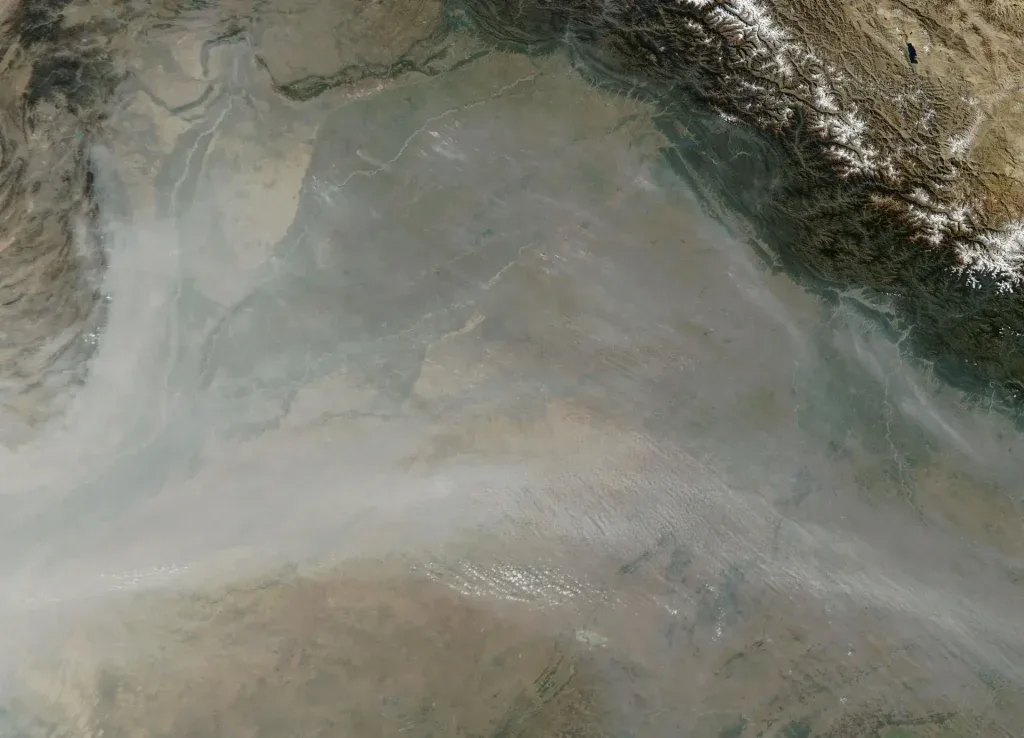
Seasonal haze over northern India, NASA MODIS satellite image of 2024 (file image), Wikimedia Commons, public domain