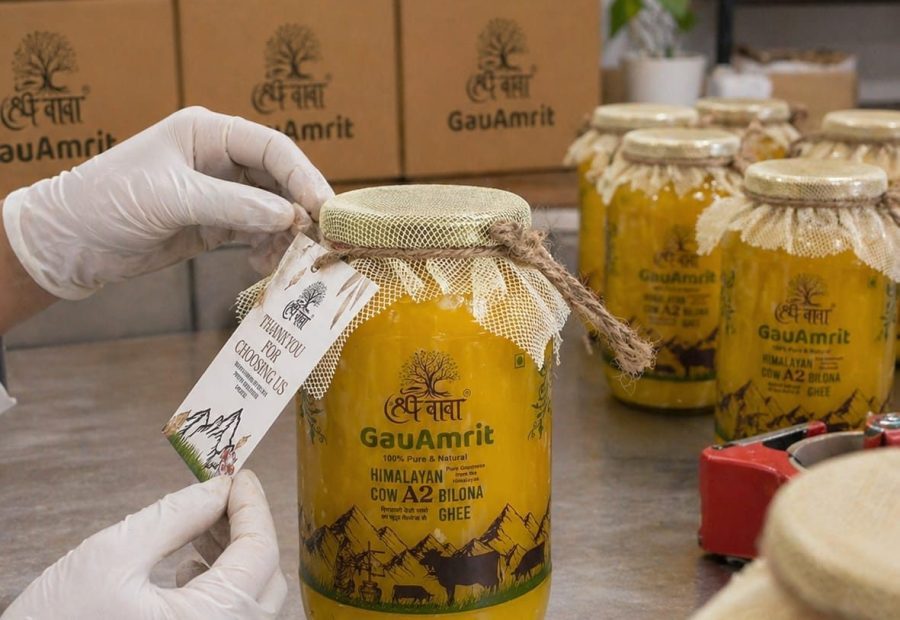
A Jabalpur-based company, Shree Baba Food India, has built its flagship brand, GauAmrit, around a combination that has become common across India's premium dairy segment: desi cow sourcing, the traditional Bilona churning method, and marketing tied to "A2" milk protein — a formula the company hopes will differentiate it in an increasingly crowded category.
Also known as Shri Sidhha Baba Food & Agro Company or Shri Sidhha Baba Industries, and owned by Shri Sidhha Baba Group, the company describes its broader mission as delivering "authentic, natural and traditionally crafted products," with GauAmrit's Desi Himalayan Cow A2 Bilona Ghee serving as its primary consumer-facing product. "At Shree Baba, our aim is to bring authentic, natural and traditionally crafted food products to modern consumers while maintaining the values of purity, quality and trust," founder Omm said. The company has not disclosed detailed corporate history, manufacturing scale, or additional product lines beyond the ghee brand.
The Claims Behind the Product
GauAmrit's core claims rest on three pillars: Bilona-method production, desi Himalayan cow sourcing, and A2 milk-protein positioning. Independent verification is limited across all three: the company has not published third-party process audits for its Bilona claims, specific supply-chain documentation for its Himalayan sourcing claims, or clinical evidence distinguishing A2 ghee's health properties from conventional ghee — and India's food regulator, FSSAI, has previously said there is insufficient scientific evidence to establish A2 dairy as nutritionally superior to A1 dairy.
A Market Opportunity Built on Heritage
None of this necessarily undermines GauAmrit's commercial appeal: India's premium ghee segment has grown substantially by combining traditional-heritage marketing with genuine consumer demand for products perceived as less industrialized, and Shree Baba Food India is entering that market alongside numerous other regional and national competitors using similar positioning.
What to Watch Going Forward
As GauAmrit competes in a segment where marketing language has become fairly standardized across brands — "desi," "A2," "Bilona," "traditional" — its longer-term differentiation will likely depend on factors the company has not yet made public: verified sourcing transparency, consistent product quality, and distribution reach beyond its current, largely undisclosed retail footprint.
Frequently Asked Questions
What makes GauAmrit different from other A2 ghee brands in India?
The company combines Bilona-method production, Himalayan desi-cow sourcing and A2 milk-protein positioning — a formula also used by several competing brands in India's premium ghee segment, making genuine differentiation dependent on verifiable, brand-specific transparency the company has not yet published.
Is GauAmrit's ghee independently verified for its purity and health claims?
The company has not published third-party certification, lab-test results or clinical studies supporting its production-process or health-related claims; FSSAI has separately stated that A2 dairy's health superiority over A1 dairy lacks sufficient scientific evidence.